Intercooler Upgrades Explained: Why Cooler Air Means More Consistent Power
Intercooler upgrades help turbocharged and supercharged vehicles control heat, reduce intake air temperatures, and deliver more consistent performance. Here’s how intercoolers work, when an upgrade makes sense, and what to consider when building a boosted car.
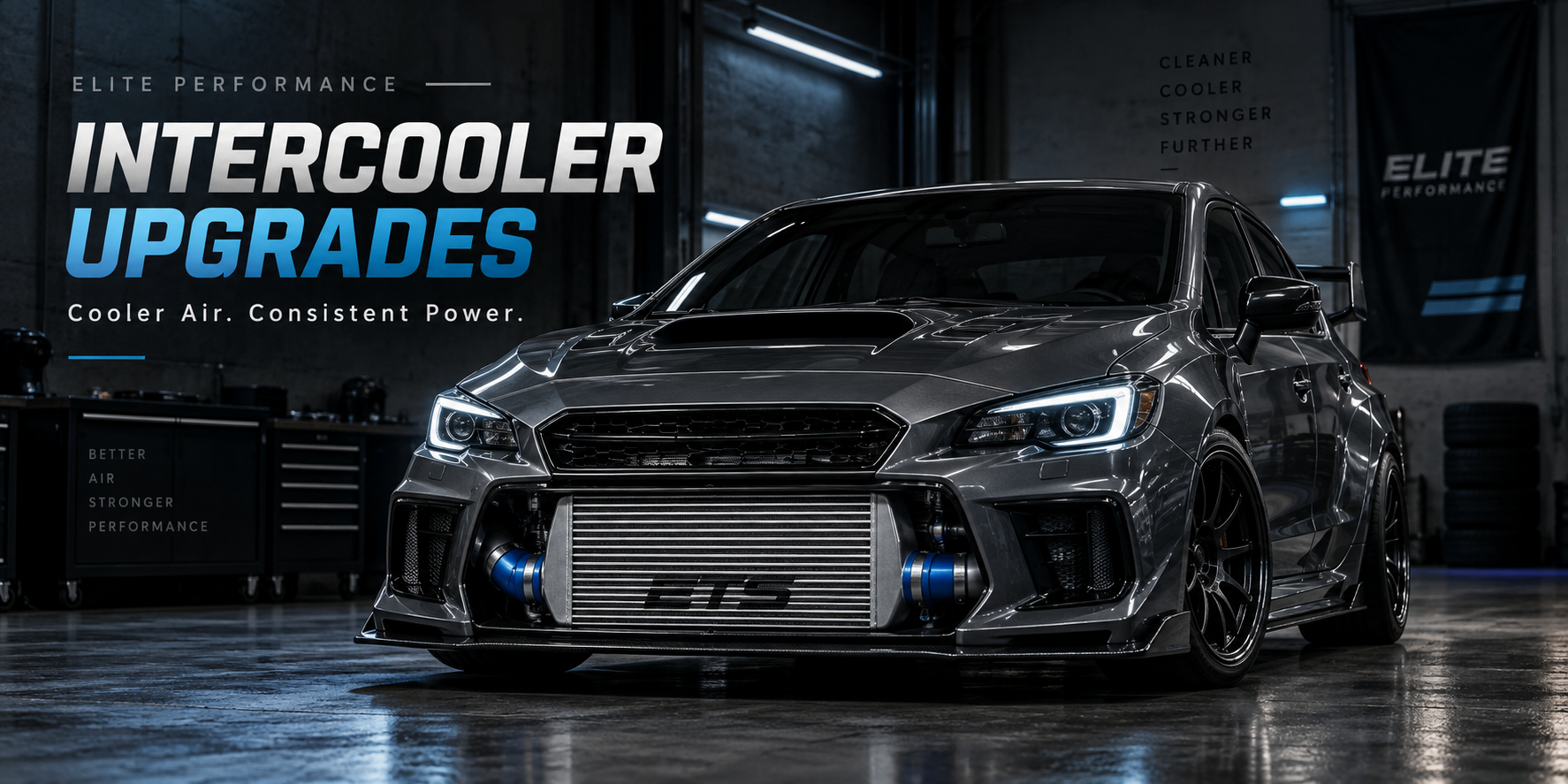
Making more boost is only part of building a faster turbocharged or supercharged car. The other challenge is controlling the heat that comes with it.
A vehicle may feel strong during the first hard pull, then begin losing consistency as temperatures rise. Hot weather, repeated acceleration, track sessions, additional boost, and larger power upgrades can all place more demand on the factory cooling system.
That is where intercooler upgrades become important.
An intercooler cools compressed intake air before it enters the engine. Keeping that air cooler can help a boosted engine maintain more consistent performance, especially as the vehicle is driven harder.
Performance cooling brands such as Mishimoto offer components designed around managing the extra heat created by modified performance vehicles.
What Does an Intercooler Do?
An intercooler is a heat exchanger positioned between the turbocharger or supercharger and the engine's intake system.
Turbochargers and superchargers compress incoming air so the engine can receive more oxygen. That additional air allows the engine to support more fuel and ultimately produce more power.
There is a downside: compressing air also increases its temperature.
An intercooler removes some of that heat before the air reaches the engine. Cooler air is denser than hotter air, which means a properly functioning intercooler can help provide the engine with a cooler and more stable intake charge.
Why Do Intake Air Temperature and Heat Soak Matter?
Intake air temperature, commonly shortened to IAT, can have a significant effect on the way a boosted vehicle performs.
As intake temperatures climb, the engine management system may respond by reducing ignition timing or making other adjustments to protect the engine from knock. The exact response depends on the vehicle, calibration, fuel, and operating conditions.
This is one reason a modified car can feel noticeably stronger in cool weather than it does during a hot summer afternoon.
What Is Heat Soak?
Heat soak occurs when the intercooler and surrounding components absorb heat faster than they can remove it.
This can happen during:
- Repeated full-throttle pulls
- Stop-and-go traffic
- Track sessions
- Dyno testing
- Hot-weather driving
- Higher-than-stock boost levels
Once the intercooler becomes heat-soaked, its ability to cool the intake charge can decrease. The vehicle may still make boost, but performance may become less consistent as temperatures continue to rise.
What Are the Different Types of Intercoolers?
Intercooler design varies significantly between vehicles. Understanding the basic layouts makes it easier to determine which type of upgrade is appropriate for a particular build.
Front-Mount Intercoolers
A front-mount intercooler, often called an FMIC, sits toward the front of the vehicle where outside air can pass directly through the core.
This layout is common on turbocharged performance cars because it gives the intercooler access to strong airflow while the vehicle is moving.
Upgraded front-mount intercoolers often increase cooling capacity through a larger or more efficient core. Brands such as COBB offer performance components for popular turbocharged platforms where controlling intake temperatures becomes increasingly important as power increases.
Top-Mount Intercoolers
A top-mount intercooler sits above the engine and typically receives outside air through a hood scoop or dedicated ducting.
This arrangement can keep charge piping relatively short, which can be beneficial for response and packaging.
The tradeoff is proximity to the engine. Because the intercooler sits inside a hot engine bay, managing heat can become more challenging during extended driving or repeated pulls.
For vehicles designed around a top-mount system, a larger or more efficient replacement can improve cooling while retaining the original layout.
Air-to-Air vs. Air-to-Water Intercoolers
An air-to-air intercooler uses outside airflow passing through the intercooler core to remove heat from the compressed intake charge.
An air-to-water system transfers heat into a liquid cooling circuit. That liquid then travels through another heat exchanger where the heat can be released.
Air-to-water systems are commonly found on certain factory-supercharged vehicles and high-performance applications where packaging or cooling requirements make them a better fit.
Neither design is automatically better for every build. Vehicle architecture, power level, available space, driving style, and cooling demands all matter.
When Does the Factory Intercooler Become a Limitation?
Factory intercoolers are engineered around the vehicle's original power level, packaging requirements, cost targets, emissions considerations, and expected operating conditions.
For a stock vehicle driven normally, the original intercooler may perform exactly as intended.
The demands change when the vehicle is modified.
Higher boost, larger turbochargers, ECU tuning, additional fueling, increased airflow, and aggressive driving can all produce more heat than the original system was designed to manage.
Common signs that additional intercooler capacity may be useful include rising intake temperatures during repeated pulls, noticeable performance loss as the vehicle gets hot, or a build that has moved significantly beyond the factory power level.
What Does an Upgraded Intercooler Actually Improve?
An intercooler should not be viewed as a magic horsepower part. Its biggest advantage is usually its ability to support the rest of the performance package.
Lower Intake Air Temperatures
A more efficient intercooler can remove more heat from the compressed intake charge, helping keep temperatures lower under demanding conditions.
This becomes increasingly important as boost and airflow increase.
More Consistent Power
Peak horsepower gets most of the attention, but consistency can matter just as much.
A vehicle that produces strong power during one pull and then becomes progressively slower as temperatures rise is not using that power very effectively.
Better heat management can help the vehicle perform more consistently during repeated acceleration, track sessions, or spirited driving.
Better Support for Modified Builds
Intercooler upgrades are especially useful when paired with modifications that increase airflow or boost.
If the turbocharger is moving substantially more air than it did in the factory configuration, the cooling system needs to keep up with that additional demand.
Pressure Drop Still Matters
Cooling efficiency is not the only measurement that matters.
Air also has to move through the intercooler efficiently. A restrictive core can create pressure drop, forcing the turbocharger or supercharger to work harder to achieve the desired boost pressure.
A well-designed intercooler balances cooling capacity with airflow.
Why Bigger Is Not Always Better
It is easy to assume the largest intercooler available must be the best one.
That is not always the case.
An unnecessarily large intercooler may add weight, complicate installation, require additional modifications, or simply provide more capacity than the vehicle needs.
The goal is not to install the largest possible core. The goal is to install an intercooler appropriately matched to the airflow, power level, vehicle, and intended use.
How Do Intercoolers Fit Into Turbo and Supercharged Builds?
Intercoolers do not operate in isolation. They are one part of the complete forced-induction system.
Turbocharged Builds
Turbocharged vehicles can place significant demands on the intercooler as boost levels increase.
ECU tuning, larger turbochargers, downpipes, intakes, fueling modifications, and other performance upgrades may all increase airflow and heat.
When planning a larger turbo or higher-boost setup, it makes sense to consider the intercooler alongside the rest of the forced-induction system rather than treating it as an unrelated modification.
Supercharged Builds
Superchargers also create heat while compressing intake air.
Depending on the platform, improving charge-air cooling may involve upgrading the intercooler core, heat exchanger, coolant pump, reservoir, or other parts of an air-to-water cooling circuit.
High-horsepower supercharged vehicles can place substantial thermal demand on these systems, making heat management an important part of the overall build.
Charge Pipes and Intercooler Piping
The intercooler itself is only one part of the airflow path.
Charge pipes, couplers, clamps, sensors, bypass valves, blow-off valves, and connections all need to function properly.
On some platforms, factory plastic piping may become a weak point as boost increases. Upgraded piping can provide additional durability or improved airflow depending on the vehicle.
Performance brands such as aFe POWER offer airflow-focused components that can be incorporated into a larger performance build.
Which Type of Build Are You?
The right intercooler depends heavily on how the vehicle is actually used. A daily-driven street car and a dedicated track vehicle do not necessarily need the same cooling capacity.
Street Builds
For a street car, the best intercooler upgrade usually balances cooling performance, fitment, response, and ease of installation.
A daily driver or weekend performance car may benefit from additional cooling capacity without needing the largest race-oriented core available.
For many street builds, the goal is simply to keep the car feeling consistent during spirited driving and leave enough cooling capacity for future modifications.
Track and Autocross Builds
Track driving creates sustained heat because the vehicle operates under heavy load for extended periods.
Repeated acceleration, higher engine speeds, limited cooldown time, and warm ambient temperatures can expose weaknesses that may never appear during normal street driving.
An upgraded intercooler can become an important part of a track-focused cooling strategy alongside oil cooling, radiator efficiency, brake cooling, and proper fluid management.
Drag and Roll Racing Builds
Drag racing and roll racing create a different type of demand.
The vehicle may experience very high boost and airflow during relatively short bursts, followed by another run before the entire system has completely cooled.
Maintaining stable intake temperatures between runs can help make performance more repeatable.
What Supporting Mods Work With an Intercooler Upgrade?
A performance build works best when its components complement one another.
Do You Need a Tune With an Intercooler?
Whether a tune is required depends on the vehicle and the intercooler design.
Many intercoolers can be installed without changing the ECU calibration. However, modified turbocharged and supercharged vehicles often use tuning to coordinate boost, fueling, ignition timing, and other engine parameters.
Always follow the requirements for the specific vehicle, intercooler, and calibration being used.
Intakes, Charge Pipes, Exhaust, and Fueling
Common modifications paired with intercooler upgrades include:
- Performance intake systems
- Charge pipes
- Turbocharger upgrades
- Supercharger upgrades
- Downpipes and exhaust systems
- Fuel system upgrades
- ECU tuning
Not every vehicle needs all of these parts. The correct combination depends on the platform and performance target.
Additional Cooling Upgrades
Intake temperatures are only one part of vehicle heat management.
Higher-output builds may also benefit from upgraded radiators, oil coolers, heat exchangers, transmission coolers, or other cooling components depending on the platform.
The goal is to control heat throughout the vehicle rather than moving the problem from one system to another.
How Do You Choose the Right Intercooler?
The best intercooler is the one that matches the vehicle and its intended use.
Before choosing an intercooler, consider:
- Your current power level
- Your future horsepower goals
- Turbocharger or supercharger size
- Expected boost pressure
- Street, track, drag, or mixed use
- Ambient temperatures
- Available installation space
- Core design and airflow
- Pressure drop
- Piping and connection requirements
There is little benefit in buying a race-oriented intercooler for a lightly modified street car if a smaller system already provides enough thermal capacity.
At the same time, choosing an intercooler with no headroom can mean replacing it again when the build progresses.
Common Intercooler Upgrade Mistakes
A few mistakes show up frequently when enthusiasts plan intercooler upgrades:
- Choosing solely by core size
- Ignoring pressure drop
- Buying an intercooler without checking vehicle fitment
- Ignoring charge pipe and coupler quality
- Leaving boost leaks unresolved
- Expecting the intercooler alone to create major horsepower
- Ignoring the rest of the cooling system
- Buying for appearance instead of the actual power goal
The intercooler should support the complete build rather than become a modification chosen in isolation.
Who Should Consider an Intercooler Upgrade?
An intercooler upgrade makes the most sense when the vehicle's factory cooling capacity no longer matches how the car is being modified or driven.
You may want to consider one if your goal is:
- Lower intake air temperatures
- Reduced heat soak
- More consistent performance during repeated pulls
- Better hot-weather performance
- Additional cooling capacity for higher boost
- Support for a larger turbocharger
- Improved thermal management for track use
- Additional headroom for future modifications
A stock daily driver may not need a larger intercooler at all. A tuned vehicle making substantially more boost than stock may benefit considerably more.
Build Power That Stays Consistent
A fast car should not only feel strong during the first pull of the day.
A properly matched intercooler helps a turbocharged or supercharged vehicle manage one of the biggest challenges created by additional power: heat.
Lower intake temperatures, better resistance to heat soak, and sufficient cooling capacity can help the rest of the performance package work more consistently.
The important part is choosing the intercooler around the vehicle, the power goal, and the way the car will actually be driven.
Whether you are building a tuned daily driver, weekend performance car, track setup, or high-horsepower project, Elite Performance can help you put together the supporting parts the build needs.
Ready to start your next upgrade? Explore performance parts at Elite Performance.