Skid Plates and Rock Sliders: Protect the Parts That Get Hit First
Skid plates and rock sliders are some of the most practical upgrades for serious off-road builds. Learn how underbody protection, rocker protection, and trail armor help protect your truck, Jeep, SUV, or overland rig when the terrain gets rough.
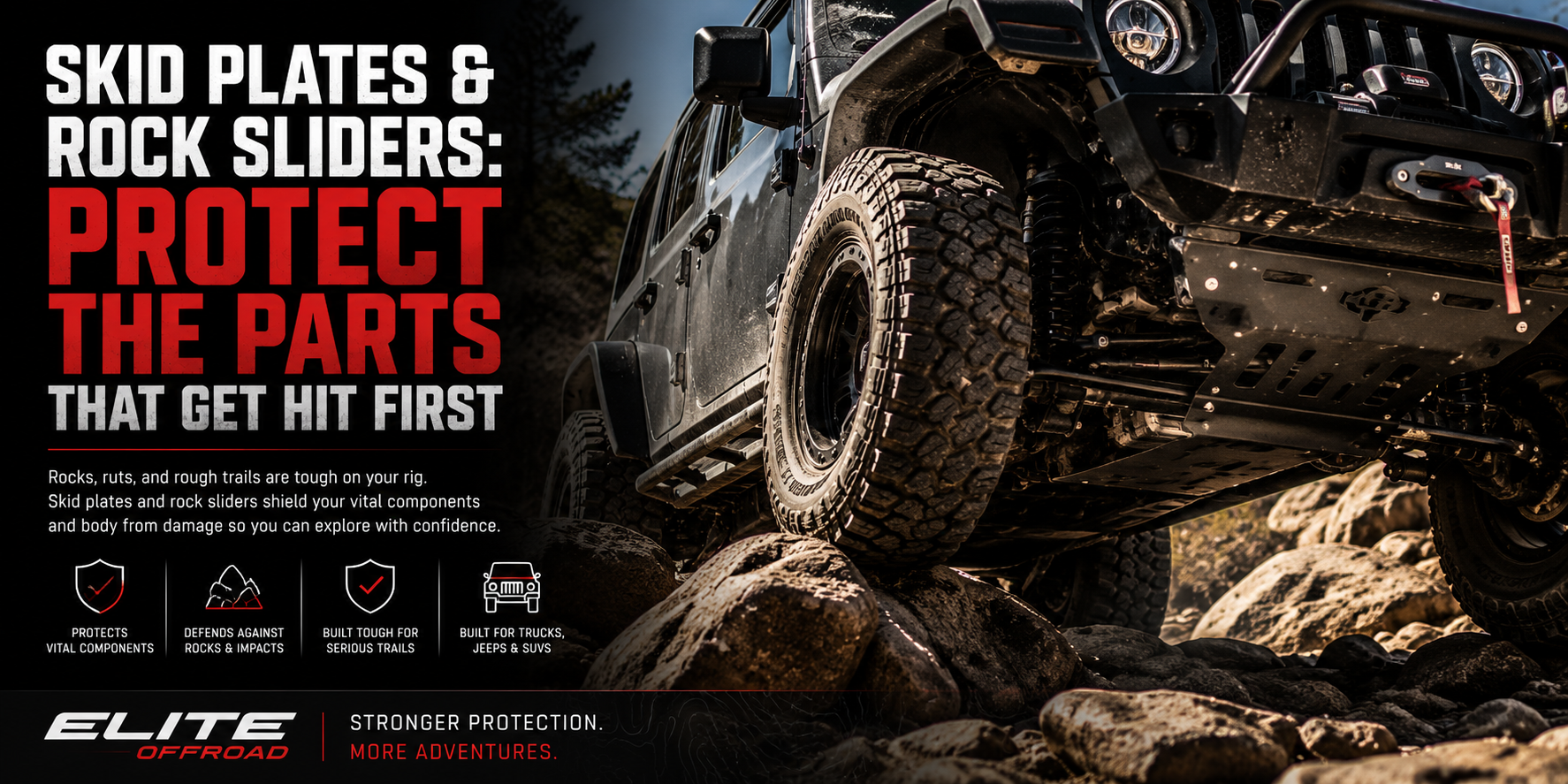
Off-road builds are often judged by what is easy to see first: tires, wheels, suspension, lights, bumpers, roof racks, and stance.
But some of the most important off-road upgrades are the parts that protect the vehicle when the trail gets rough.
That is where skid plates and rock sliders matter.
Skid plates, rock sliders, and underbody protection help protect the parts of your truck, Jeep, SUV, or overland build that are most likely to take hits on rocks, ruts, ledges, and uneven terrain. They may not always be the flashiest upgrades, but they can save expensive components from trail damage.
At Elite Offroad, we focus on upgrades that serve a real purpose. If your build is going to leave pavement, protection should be part of the plan.
Why Off-Road Protection Matters
Off-road terrain is unpredictable. Rocks, stumps, ruts, ledges, washouts, and deep trail obstacles can contact parts of the vehicle that were never meant to take a direct hit.
Factory components may be fine for normal road use, but trail driving creates different risks. Oil pans, transfer cases, fuel tanks, differentials, exhaust components, rocker panels, and lower body panels can all be exposed depending on the vehicle and terrain.
One hard impact can turn a good trail day into a damaged vehicle, a recovery situation, or an expensive repair.
What Are Skid Plates?
Skid plates are protective panels mounted underneath the vehicle. Their job is to help shield important components from impact, scraping, and trail damage.
Depending on the vehicle, skid plates may protect the engine, transmission, transfer case, fuel tank, differential, steering components, or other vulnerable areas.
A good skid plate does not make the vehicle invincible, but it gives the underbody a much better chance of surviving contact with obstacles.
What Are Rock Sliders?
Rock sliders are protective bars or rails mounted along the lower sides of the vehicle, usually near the rocker panels.
Their purpose is to protect the sides of the vehicle when the body comes close to rocks, ledges, stumps, or trail obstacles. On a truck, Jeep, or SUV, the rocker area is one of the easiest places to damage off-road.
Rock sliders are especially useful because rocker panel damage can be expensive and difficult to repair. A proper slider can take the hit instead of the body.
Rock Sliders vs Side Steps
Rock sliders and side steps are not the same thing.
Side steps are usually designed to help people get in and out of the vehicle. They may look rugged, but many are not built to support the weight of the vehicle against rocks or trail obstacles.
Rock sliders are designed for protection. They are typically stronger, mounted more securely, and built to handle impact. Some sliders also function as steps, but their main job is protecting the vehicle.
If your vehicle sees real trails, make sure you are choosing sliders, not just decorative steps.
Why Rocker Panels Need Protection
The rocker panels run along the lower sides of the vehicle between the front and rear wheels. On many vehicles, this area sits low enough to be vulnerable on uneven terrain.
When crossing rocks, dropping into ruts, or sliding against obstacles, the rocker area can take serious damage. Dented rockers, crushed lower body panels, and damaged doors can happen quickly if the vehicle is not protected.
Rock sliders create a stronger contact point that helps protect the body from those impacts.
Common Areas Skid Plates Protect
Different vehicles need different protection, but several areas are common priorities.
- Engine and oil pan protection
- Transmission protection
- Transfer case protection
- Fuel tank protection
- Differential protection
- Steering component protection
- Lower radiator or front underbody protection
The best skid plate setup depends on the vehicle, terrain, lift height, tire size, and how aggressively the vehicle is driven.
Engine and Oil Pan Protection
The engine oil pan is one of the most important components to protect. If the oil pan is damaged badly enough, the engine can lose oil quickly.
That can turn a trail impact into a major mechanical problem.
An engine skid plate helps shield the lower engine area from rocks and debris. For vehicles that see rocky trails, rough roads, or remote travel, this can be a very smart upgrade.
Transfer Case Protection
The transfer case is critical on four-wheel-drive vehicles. It helps send power to the front and rear axles when 4WD is engaged.
Because it often sits under the vehicle, it can be vulnerable to rocks and trail impacts. A damaged transfer case can leave the vehicle unable to continue safely.
Transfer case skid plates are especially important on vehicles used for rock crawling, overlanding, and remote trail driving.
Fuel Tank Protection
Fuel tank protection matters because the fuel tank can be exposed on certain vehicles. A hard hit to the tank area can create a serious issue, especially far from help.
Fuel tank skid plates help protect the tank from rocks, ruts, and trail obstacles.
For overland builds, this is especially important because the vehicle may be traveling long distances in remote areas where damage can be harder to deal with.
Differential Protection
Differentials are often exposed on solid axle vehicles and many off-road builds. The differential housing can hit rocks, ledges, and trail obstacles.
Differential covers or differential skids can help protect this area from damage. This is especially useful for Jeeps, trucks, and rock-focused builds.
A strong differential cover can also add peace of mind when driving through rough terrain where the axle may contact obstacles.
Material Matters
Skid plates and rock sliders are commonly made from steel or aluminum, depending on the application and design.
Steel is strong and impact-resistant, making it a popular choice for rock sliders and heavy-duty protection. It can take hard hits, but it is heavier and may require coating maintenance to prevent corrosion.
Aluminum is lighter and corrosion-resistant, which can be useful for overland builds and vehicles where weight matters. It may not be the best choice for every extreme rock-crawling situation, but it can be a strong option for many drivers.
The right material depends on the vehicle, terrain, weight goals, and how hard the parts will be used.
Weight Is Part of the Build Plan
Protection adds weight. Skid plates, rock sliders, bumpers, winches, roof racks, recovery gear, and larger tires can all add up quickly.
That weight affects suspension, braking, fuel economy, ride quality, and handling.
This does not mean you should avoid protection. It means the build should be planned as a system. If the vehicle gains significant weight, the suspension and tires may need to support that added load properly.
Skid Plates for Daily-Driven Off-Road Builds
Many off-road vehicles are still daily drivers. They need to handle errands, highway driving, family trips, and work use during the week, then trails on the weekend.
For these vehicles, protection should be chosen carefully. A full heavy-duty armor setup may not be necessary for a mild trail build, but targeted protection can still make sense.
Engine, transfer case, and rocker protection are often strong starting points for drivers who want real trail confidence without overbuilding the vehicle.
Protection for Overlanding
Overland builds often travel long distances and may drive through remote areas where help is not nearby. That makes protection especially important.
An overland vehicle may not be rock crawling every weekend, but it can still encounter rough roads, deep ruts, uneven terrain, and unexpected obstacles.
Skid plates and rock sliders can help prevent damage that would otherwise interrupt a trip or leave the vehicle stranded.
Protection for Rock Crawling
Rock crawling puts underbody protection to the test. When the vehicle moves over rocks, contact is almost guaranteed.
For rock-focused builds, strong sliders and skid plates are not optional. They allow the vehicle to slide, pivot, and move over obstacles while reducing the risk of body and underbody damage.
In this type of use, strength and mounting quality matter heavily.
Mounting Quality Matters
Protection parts are only as good as their mounting points. A skid plate or slider that looks strong but mounts poorly may fail when it takes a hard hit.
Rock sliders should be mounted securely to handle real contact. Skid plates should attach in a way that supports impact loads and does not create weak points.
Fitment, hardware, and installation quality all matter.
Ground Clearance and Protection
Skid plates and sliders protect the vehicle, but they can also affect clearance depending on their design.
A good skid plate should protect vulnerable components without hanging unnecessarily low. A good rock slider should protect the body without reducing clearance more than necessary.
The best protection follows the shape of the vehicle and supports trail use without creating new obstacles underneath.
Pairing Armor With Other Off-Road Upgrades
Skid plates and rock sliders work best as part of a complete off-road build. Tires, suspension, lockers, recovery gear, lighting, and armor all support different parts of trail performance.
For example, larger tires help with ground clearance. Suspension helps control the vehicle. Lockers help maintain traction. Recovery gear helps when the vehicle gets stuck. Skid plates and sliders help protect the vehicle when contact happens.
A capable build should not rely on one upgrade alone.
Who Should Consider Skid Plates and Rock Sliders?
Skid plates and rock sliders are a smart option for drivers who want to protect their vehicle during real off-road use.
You should consider skid plates and rock sliders if you want:
- Better underbody protection on rough terrain
- Protection for rocker panels and lower body areas
- More confidence on rocks, ruts, and ledges
- A stronger setup for overlanding or remote travel
- Protection for expensive drivetrain components
- A more complete truck, Jeep, SUV, or trail build
- Functional upgrades beyond appearance alone
Common Protection Mistakes
Many off-road protection mistakes come from choosing parts based only on appearance.
- Buying side steps instead of real rock sliders
- Ignoring underbody protection until damage happens
- Choosing heavy armor without considering suspension needs
- Installing parts with weak mounting points
- Not checking clearance after installation
- Assuming a lift kit eliminates the need for protection
- Forgetting that overland vehicles need protection too
The best protection setup is chosen based on terrain, vehicle use, and the parts most likely to be damaged.
Build for the Hits You Cannot Avoid
Off-roading always brings risk. You can choose a careful line, drive smart, and build the vehicle well, but trail contact still happens.
Skid plates and rock sliders help protect the vehicle when that contact happens. They are practical upgrades that support real off-road confidence.
At Elite Offroad, we help drivers build vehicles with purpose. If your truck, Jeep, SUV, or overland rig is going to see rocks, ruts, ledges, or remote terrain, protection should be part of the build plan.
Ready to protect your build? Explore skid plates, rock sliders, armor, and off-road protection upgrades at Elite Offroad.