Tire Compounds Explained: How Rubber Affects Grip, Comfort, and Tire Life
Tire compounds play a major role in traction, ride quality, tread life, wet grip, winter performance, off-road durability, and overall driving feel. Learn how different tire compounds work and why the right rubber matters for your vehicle.
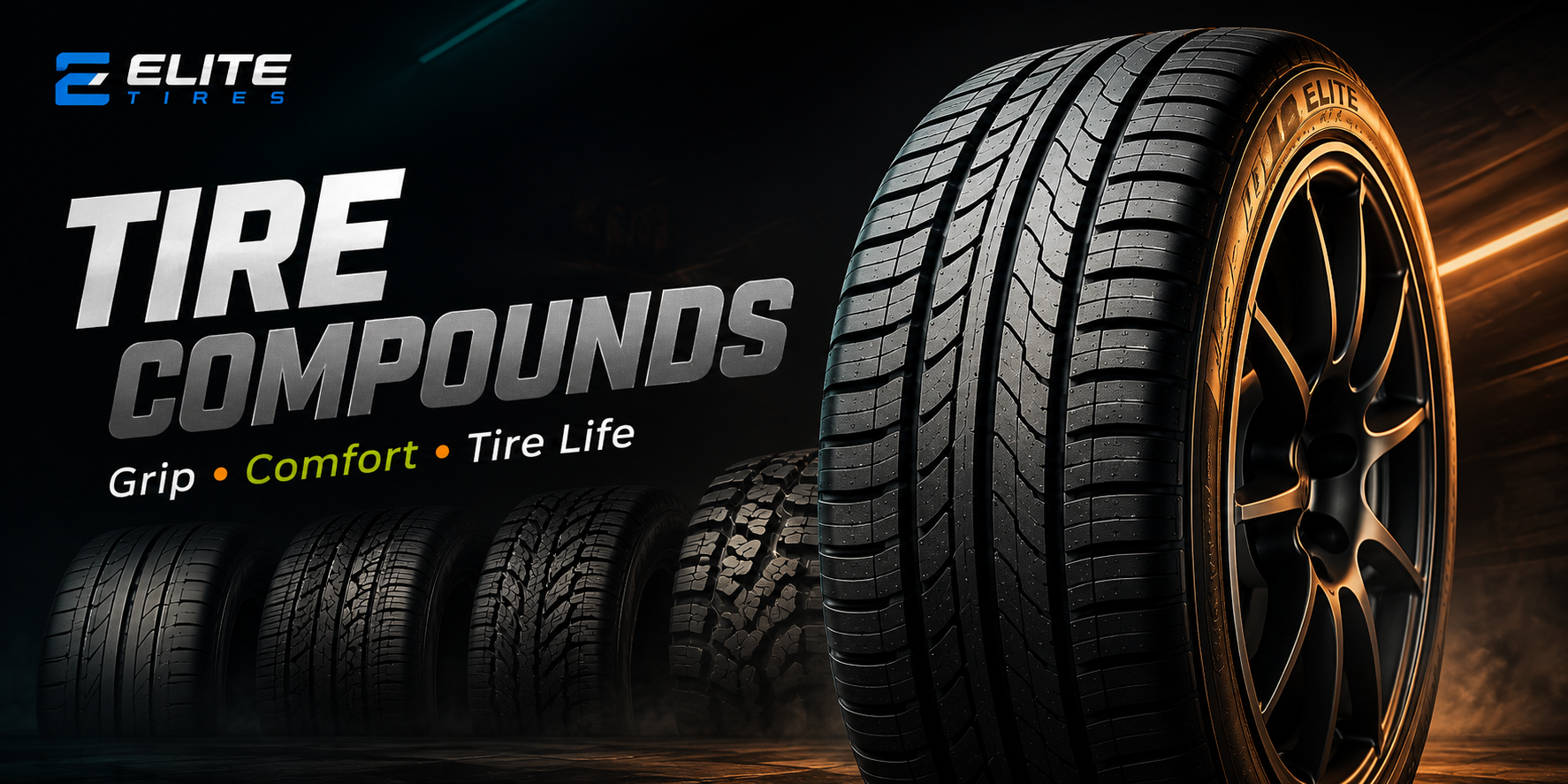
Most drivers compare tires by size, brand, tread pattern, price, and maybe mileage rating. Those details matter, but one of the most important parts of a tire is something you cannot fully judge just by looking at it.
The compound.
A tire compound is the rubber blend used to create the tire. That blend affects how the tire grips, wears, handles heat, performs in cold weather, responds in rain, feels on the road, and survives rough terrain.
At Elite Tires, we believe tire choice should be based on how the vehicle is actually used. A daily driver, sports car, lifted truck, winter commuter, off-road rig, and highway SUV all need different things from a tire. Understanding tire compounds helps explain why one tire may feel amazing in one situation and completely wrong in another.
What Is a Tire Compound?
A tire compound is the specific mixture of rubber and other materials used in the tire. Manufacturers use different blends depending on the tire’s purpose.
The compound can include natural rubber, synthetic rubber, carbon black, silica, oils, resins, and other materials designed to change how the tire behaves. Some compounds are built for grip. Some are built for long tread life. Some are designed for cold weather flexibility. Others are made for heat resistance, fuel economy, or off-road durability.
This is why two tires with similar tread patterns can perform very differently. The rubber itself matters.
Soft Tire Compounds
Soft tire compounds are usually designed for grip. They can conform to the road surface more easily, which helps increase traction during acceleration, braking, and cornering.
Performance tires, summer tires, track tires, and drag tires often use softer compounds because grip is the priority. A softer tire can make a car feel more responsive, more planted, and more confident under hard driving.
The tradeoff is tread life. Softer compounds usually wear faster, especially under aggressive driving, high heat, heavy vehicles, or poor alignment.
Hard Tire Compounds
Harder tire compounds are usually designed for longer tread life, durability, and lower rolling resistance. They may not grip as aggressively as soft performance compounds, but they can last longer and often work well for daily driving, commuting, and highway use.
Touring tires, some all-season tires, commercial tires, and many long-mileage tires use harder compound strategies to improve durability and wear.
The tradeoff is that a harder compound may not deliver the same level of braking grip, cornering response, or cold-weather traction as a softer or more specialized compound.
Summer Tire Compounds
Summer tires are built for warm-weather performance. Their compounds are designed to stay stable and grippy in higher temperatures.
On a performance car, a good summer tire can improve steering feel, braking, dry traction, and wet-weather control compared to a basic all-season tire. This is why summer tires are popular on sports cars, muscle cars, performance sedans, and enthusiast builds.
The important thing to understand is that summer tire compounds are not designed for freezing temperatures. In cold weather, the rubber can become too stiff, which reduces traction and can make the tire unsafe for winter driving.
All-Season Tire Compounds
All-season tires are designed to work across a wider range of conditions. Their compounds try to balance dry grip, wet traction, tread life, ride comfort, noise, and light cold-weather use.
The benefit of an all-season compound is versatility. For many daily drivers, all-season tires make sense because they do a lot of things reasonably well.
The tradeoff is that all-season tires are usually not the best at any one extreme. They typically do not grip like a true summer performance tire, and they do not perform in snow and freezing temperatures like a dedicated winter tire.
All-Weather Tire Compounds
All-weather tires are different from standard all-season tires. They are designed to provide more serious cold-weather and winter capability while still being usable year-round.
The compound in an all-weather tire is usually built to stay more flexible in colder temperatures than a typical all-season tire. Many all-weather tires also carry the three-peak mountain snowflake rating, depending on the specific model.
For drivers who do not want to swap between summer and winter tires, an all-weather tire can be a strong compromise. It will not always match a dedicated winter tire in harsh conditions, but it can offer better winter confidence than many standard all-season options.
Winter Tire Compounds
Winter tires use compounds designed to stay flexible in cold temperatures. That flexibility is critical because a tire that becomes hard in the cold cannot grip the road properly.
Winter compounds help the tire bite into snow, ice, slush, and cold pavement. Combined with winter-specific tread patterns and siping, the compound helps improve braking, turning, and acceleration in cold conditions.
The tradeoff is warm-weather wear. Winter tires are not meant for hot weather. Driving them in warm conditions can cause faster wear, softer handling, and reduced performance.
Performance Tire Compounds
Performance tire compounds are designed around grip, response, and driver confidence. These tires are often used on sports cars, muscle cars, tuned vehicles, and performance sedans.
A performance compound can help the vehicle feel sharper. It can improve cornering, braking, and throttle response because the tire is able to transfer more of the vehicle’s power and movement to the road.
The tradeoff is that performance tires often wear faster, may ride firmer, and may not perform well in cold weather unless they are specifically designed as performance all-season tires.
Ultra-High-Performance Tire Compounds
Ultra-high-performance tires take the grip-focused idea even further. These tires are designed for drivers who want stronger handling, better feedback, and more confidence at higher speeds or under harder driving.
The compounds used in these tires are often more aggressive than standard touring or basic all-season tires. They may provide excellent dry and wet grip, but they usually come with compromises in tread life, road noise, comfort, or winter ability.
For the right vehicle, the difference can be dramatic. A powerful car on weak tires can feel nervous and traction-limited. The same car on the right performance compound can feel much more controlled.
Drag Tire Compounds
Drag tires are designed to help put power down in a straight line. Their compounds are typically softer and stickier than normal street tires, which helps with launch traction.
For high-horsepower vehicles, the tire compound can be the difference between spinning and moving. A drag radial or street/strip tire can help powerful rear-wheel-drive cars use more of their power during acceleration.
The tradeoff is that drag-focused compounds may not be ideal for rain, cold weather, cornering, or long tread life. They are built for a specific purpose, and that purpose is traction under hard acceleration.
Touring Tire Compounds
Touring tires are designed for comfort, quiet ride quality, predictable handling, and longer tread life. Their compounds usually focus on balance instead of maximum grip.
For commuter cars, family SUVs, crossovers, and highway vehicles, a touring compound can be a smart choice. It may not feel as sharp as a performance tire, but it can be more comfortable, quieter, and longer lasting.
The right touring tire compound helps make everyday driving smoother and more predictable.
Truck and SUV Tire Compounds
Truck and SUV tires often need compounds that can handle more weight, larger tire sizes, towing, hauling, road trips, and mixed driving conditions.
A tire on a full-size truck has a different job than a tire on a compact car. It may need more durability, stronger load capacity, better heat resistance, and improved wear characteristics.
This is why choosing truck tires only by appearance can be a mistake. The compound and construction need to match how the truck is used.
All-Terrain Tire Compounds
All-terrain tires are designed for drivers who split time between pavement and off-road use. Their compounds need to balance road wear, cut resistance, tread durability, wet traction, and off-road grip.
A good all-terrain compound should survive gravel, dirt, rocks, and rough surfaces while still driving comfortably on the highway.
The tradeoff is balance. An all-terrain tire may not be as quiet or efficient as a highway tire, but it is much more capable when the road turns into a trail.
Mud-Terrain Tire Compounds
Mud-terrain tires are built for aggressive off-road traction. Their compounds and tread designs are made to handle mud, rocks, loose dirt, ruts, and rough trails.
The compound needs to resist cuts, chips, and tearing while still providing traction in harsh conditions. Sidewall strength and tread block durability matter heavily in this category.
The tradeoff is that mud-terrain tires are often louder, rougher, heavier, and faster wearing on pavement compared to all-terrain or highway tires.
EV Tire Compounds
Electric vehicles create unique tire demands. They are often heavier than similar gas vehicles and produce instant torque, which can increase tire wear if the compound is not designed for it.
EV-focused tire compounds may be built to handle extra weight, reduce rolling resistance, manage road noise, and support long tread life under high torque loads.
For EV drivers, choosing the right tire compound can affect range, comfort, tread life, and traction.
Silica and Wet Traction
Silica is often used in tire compounds to help improve wet traction and rolling efficiency. It can allow a tire to grip better in wet conditions while still supporting lower rolling resistance compared to older compound approaches.
This is one reason many modern all-season, summer, and touring tires advertise wet performance and efficiency improvements.
For daily drivers, wet traction is one of the most important real-world benefits of a good compound. A tire that performs well in the rain can make the vehicle feel much safer and more predictable.
Carbon Black and Durability
Carbon black has long been used in tire rubber to help improve strength, wear resistance, and durability. It also gives tires their black color.
Different compound blends use carbon black and other materials in different ways depending on the tire’s purpose.
For tires that need durability, heat resistance, and tread life, the compound balance is extremely important.
Heat Cycles and Tire Performance
Heat changes how tires behave. Performance tires, track tires, and drag tires are especially affected by temperature and heat cycles.
A tire may need heat to reach its ideal grip level, but repeated heat cycles can also change the compound over time. As tires age and go through repeated heating and cooling, the rubber can become less effective.
This is one reason a tire can have tread left but still feel worse than it did when new.
Cold Weather and Compound Flexibility
Cold weather can make the wrong tire compound stiff and less effective. When rubber loses flexibility, traction drops.
This is why winter tires are so different from summer tires. A summer tire may grip well in warm weather, but it can become hard and unreliable in freezing temperatures. A winter tire stays more flexible when temperatures drop.
Choosing the wrong compound for the climate can affect braking, steering, and overall safety.
Compound vs Tread Pattern
Tread pattern is easy to see, but compound is just as important. The tread pattern controls how the tire channels water, bites into snow, clears mud, or contacts the road. The compound controls how the rubber interacts with the surface.
A great tread pattern with the wrong compound will still have limitations. A strong compound with the wrong tread design may also fall short.
The best tire uses the right compound and tread design for the job.
Treadwear Ratings and Compound
Treadwear ratings can give a general idea of expected wear, but they should not be treated as the full story. Different tire categories, brands, vehicles, driving styles, alignments, and climates all affect real-world tire life.
A higher treadwear number often suggests longer wear, while a lower number may suggest a softer, more grip-focused compound. But comparisons are most useful within similar tire categories.
For example, comparing a touring tire to a performance tire only by treadwear rating can be misleading because they are built for different priorities.
How Driving Style Affects Compound Wear
The same tire can wear very differently depending on how it is driven.
Hard acceleration, aggressive braking, fast cornering, heavy loads, poor alignment, low tire pressure, and high heat can all increase wear. A soft performance compound will wear even faster if the vehicle is driven aggressively.
This is why tire choice should match not only the vehicle, but also the driver.
Choosing the Right Tire Compound
The right tire compound depends on how and where you drive.
- Choose summer or performance compounds for warm-weather grip and sharper handling
- Choose all-season compounds for everyday versatility
- Choose all-weather compounds if you want stronger year-round cold-weather capability
- Choose winter compounds for snow, ice, and freezing temperatures
- Choose touring compounds for comfort, low noise, and longer tread life
- Choose all-terrain compounds for mixed pavement and trail use
- Choose mud-terrain compounds for more aggressive off-road conditions
- Choose drag-focused compounds for straight-line traction
Do Not Choose Tires by Looks Alone
A tire can look aggressive and still be wrong for the vehicle. A soft compound may grip well but wear too quickly for your driving habits. A hard compound may last longer but fail to provide the performance you want.
This is why tires should be chosen by purpose first. Looks matter, but performance, safety, and usability matter more.
Build Around the Right Rubber
Tire compounds affect almost everything a tire does. Grip, tread life, comfort, road noise, wet traction, winter confidence, off-road durability, and performance all start with the rubber.
At Elite Tires, we help drivers choose tires based on real use. Whether you drive a daily commuter, lifted truck, performance car, family SUV, off-road rig, or weekend toy, the right tire compound can completely change how the vehicle feels.
Ready to choose tires that match your driving style? Explore tire options, fitment guidance, and performance tire upgrades at Elite Tires.