Tire Rotation Explained: Why Moving Your Tires Helps Them Last Longer
Tire rotation helps tires wear more evenly, last longer, and perform more consistently. Learn why rotation matters, how different rotation patterns work, and what drivers should know for front-wheel drive, rear-wheel drive, all-wheel drive, trucks, SUVs, and staggered setups.
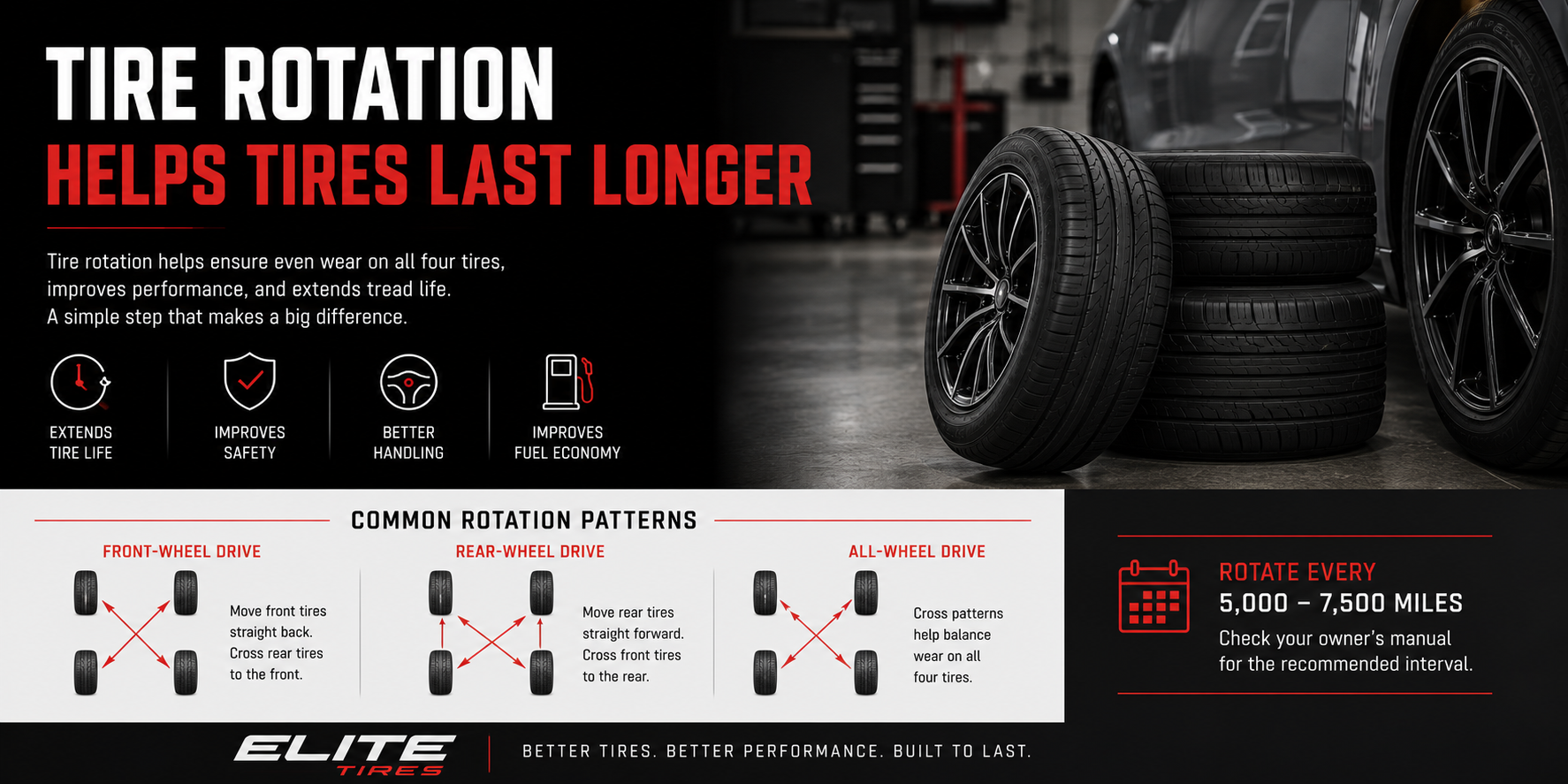
Tires do a lot more than simply roll down the road. They carry the weight of the vehicle, handle braking, steering, acceleration, cornering, weather, road impacts, and changing driving conditions.
Because each tire does a slightly different job depending on where it sits on the vehicle, tires do not always wear evenly.
That is why tire rotation matters.
Tire rotation is the process of moving tires from one position on the vehicle to another. Done correctly, it helps spread wear more evenly across the full set of tires. That can improve tread life, maintain better traction, support smoother driving, and help you get more value from your tires.
At Elite Tires, we believe tire care should be part of the full ownership experience. Choosing the right tires matters, but maintaining them correctly matters too.
What Is Tire Rotation?
Tire rotation means changing the position of each tire on the vehicle. A tire may move from front to rear, rear to front, or side to side depending on the vehicle and tire setup.
The goal is to help all four tires wear as evenly as possible over time.
Front tires, rear tires, left-side tires, and right-side tires can all experience different wear patterns. Rotation helps balance that wear so one pair of tires does not wear out much faster than the others.
Why Tire Rotation Matters
Tire rotation matters because uneven wear can reduce performance, shorten tire life, and affect the way the vehicle feels.
If the front tires wear faster than the rear tires, the vehicle may lose steering grip sooner. If the rear tires wear unevenly, the vehicle may feel less stable. If one tire develops a bad wear pattern, it may create road noise, vibration, or reduced traction.
Rotating tires helps keep tread depth more consistent across the set. That supports better braking, handling, wet traction, and overall ride quality.
Front Tires Usually Work Hard
On many vehicles, the front tires do a lot of the work. They handle steering, much of the braking load, and in front-wheel-drive vehicles, they also handle acceleration.
Because of this, front tires often wear faster than rear tires.
This is especially noticeable on front-wheel-drive cars and crossovers. Without rotation, the front tires may wear out much sooner than the rear tires, forcing you to replace tires earlier or drive with mismatched tread depth.
Rear Tires Matter Too
Rear tires are just as important. They help keep the vehicle stable, especially during cornering, braking, wet conditions, and emergency maneuvers.
Drivers sometimes focus only on the front tires because they are responsible for steering, but rear tire traction is critical for stability.
If rear tires are worn, the vehicle may be more likely to feel unstable in wet or slippery conditions. A balanced tire set helps the vehicle behave more predictably.
How Often Should Tires Be Rotated?
A common general guideline is to rotate tires every 5,000 to 7,500 miles, but the correct interval can depend on the vehicle, tire type, drivetrain, driving style, and manufacturer recommendations.
Some drivers rotate tires every time they get an oil change. Others follow the tire manufacturer or vehicle manufacturer schedule.
Vehicles that tow, haul, drive aggressively, use performance tires, or spend time off-road may benefit from more frequent inspections and rotations.
Front-Wheel Drive Rotation Pattern
Front-wheel-drive vehicles often wear the front tires faster because those tires handle steering, braking, and power delivery.
A common rotation pattern for front-wheel-drive vehicles is to move the front tires straight back and bring the rear tires forward while crossing sides.
This helps balance the heavier wear from the front axle and gives each tire a chance to work in different positions over time.
Rear-Wheel Drive Rotation Pattern
Rear-wheel-drive vehicles send power to the rear tires, while the front tires still handle steering and much of the braking.
A common rotation pattern for rear-wheel-drive vehicles is to move the rear tires straight forward and bring the front tires to the rear while crossing sides.
This pattern helps balance wear between the drive axle and steering axle.
All-Wheel Drive and Four-Wheel Drive Rotation
All-wheel-drive and four-wheel-drive vehicles can be more sensitive to tire wear differences. Because all four tires are connected through the drivetrain, mismatched tread depth can sometimes create additional stress on drivetrain components.
Regular rotation is especially important on these vehicles because it helps keep tread depth more even across the full set.
A common rotation pattern for many all-wheel-drive and four-wheel-drive vehicles is an X-pattern or a modified cross pattern, depending on the tire type and vehicle requirements.
Directional Tires
Directional tires are designed to roll in one direction. They usually have arrows on the sidewall showing the correct direction of rotation.
Because of this design, directional tires are usually rotated front to rear on the same side of the vehicle. They should not be crossed side to side unless the tires are dismounted and remounted correctly.
Directional tread patterns are often used for wet traction, performance driving, or winter traction, so maintaining the correct direction is important.
Staggered Wheel and Tire Setups
A staggered setup means the front and rear tires are different sizes. This is common on many performance cars, sports cars, and custom wheel setups.
When the front and rear tires are different sizes, traditional front-to-rear rotation may not be possible.
If the tires are not directional, they may sometimes be rotated side to side on the same axle. If they are directional and staggered, rotation options may be very limited.
This is one reason staggered setups can wear tires faster and cost more to maintain. The look and performance benefits may be worth it, but drivers should understand the tradeoff.
Square Setups
A square setup means all four tires are the same size. This usually gives the most flexibility for tire rotation.
Many daily drivers, trucks, SUVs, and performance cars use square setups because they allow more rotation options and can help extend tire life.
For drivers who care about long-term tire cost and even wear, a square setup can be a practical choice.
Truck and SUV Tire Rotation
Trucks and SUVs often place heavy demands on tires. Towing, hauling, larger tires, off-road use, and heavier vehicle weight can all affect wear.
Regular tire rotation is especially important for trucks and SUVs because uneven wear can become expensive quickly. Larger tires often cost more, so maintaining them properly helps protect the investment.
For lifted trucks or off-road builds, rotation should also be paired with regular inspections for cupping, chopping, sidewall damage, uneven tread blocks, and alignment issues.
Five-Tire Rotation With a Full-Size Spare
Some trucks, Jeeps, SUVs, and off-road vehicles carry a full-size matching spare tire. In these cases, a five-tire rotation may be possible.
A five-tire rotation includes the spare in the rotation pattern so all five tires wear more evenly over time.
This can be helpful for off-road vehicles because the spare is more likely to match the tread depth of the other tires if it is ever needed. However, the spare must be the same size, type, and compatible with the rest of the set.
Rotation and Tire Pressure
Tire rotation should be paired with a tire pressure check. The correct PSI helps each tire maintain its proper shape and contact patch.
If tires are rotated but pressure is ignored, uneven wear can still happen.
After rotating tires, pressure should be adjusted to the vehicle’s recommended settings. Some vehicles use different front and rear pressures, so this step matters.
Rotation and Alignment
Tire rotation helps even out normal wear, but it does not fix alignment problems.
If a vehicle has bad alignment, tires may continue to wear unevenly even if they are rotated on schedule. Common signs of alignment issues include inner edge wear, outer edge wear, feathering, pulling, or a steering wheel that is not centered.
If abnormal wear appears during rotation, the alignment should be checked.
Rotation and Balancing
Tire rotation and wheel balancing are different services.
Rotation changes the position of the tires. Balancing corrects uneven weight distribution in the wheel and tire assembly.
If the vehicle has vibration after a rotation, balancing may need to be checked. A tire can be rotated correctly and still vibrate if the wheel and tire assembly is out of balance.
Rotation and Tire Wear Patterns
Tire rotation is also a chance to inspect tread wear. Different wear patterns can tell you what may be happening with the vehicle.
- Center wear may suggest overinflation
- Shoulder wear may suggest underinflation
- Inner or outer edge wear may suggest alignment issues
- Cupping or chopping may suggest suspension or balance problems
- Uneven wear across one axle may suggest pressure, alignment, or driving habit issues
Rotation gives you a regular opportunity to catch these issues early.
Can You Rotate Tires Yourself?
Some drivers rotate tires at home, but it requires the right tools, safe lifting equipment, proper torque procedures, and an understanding of the correct rotation pattern.
The vehicle must be lifted safely and supported properly. Lug nuts must be torqued correctly after installation. Tire pressure should be checked, and the vehicle should be test-driven carefully.
If you are not comfortable doing this safely, it is better to have the tires rotated by a qualified professional.
Do New Tires Need Rotation?
Yes. New tires should still be rotated according to the recommended interval.
Some drivers wait until they see uneven wear before rotating, but that defeats the purpose. Rotation works best as prevention.
Starting a rotation routine early helps keep the set wearing evenly from the beginning.
What Happens If You Never Rotate Tires?
If tires are never rotated, one pair may wear out much faster than the other. The vehicle may also develop road noise, vibration, uneven tread wear, and reduced wet traction.
In some cases, the tires may become too uneven to correct with rotation later.
Skipping rotation can shorten tire life and make the vehicle feel worse over time.
Common Tire Rotation Mistakes
Many tire wear problems come from simple maintenance mistakes.
- Waiting too long between rotations
- Using the wrong rotation pattern
- Crossing directional tires incorrectly
- Trying to rotate staggered tires front to rear
- Not checking tire pressure after rotation
- Ignoring abnormal wear patterns
- Not re-torquing lug nuts correctly
- Forgetting the full-size spare when five-tire rotation is appropriate
Build Better Tire Life
Tire rotation is one of the easiest ways to help tires last longer and perform more consistently. It helps spread wear across the full set, supports better traction, and gives drivers a chance to catch problems before they become expensive.
Whether you drive a daily commuter, family SUV, lifted truck, performance car, EV, or off-road build, tire rotation should be part of your regular maintenance routine.
At Elite Tires, we help drivers choose the right tires and get the most out of them. A good tire setup is not only about buying the right tires. It is also about maintaining them the right way.
Ready to get more life from your tires? Explore tire options, fitment guidance, and tire maintenance essentials at Elite Tires.